
Monday, September 1 2025Engineering Teams Product Mindset: Why It Matters and How to Build It
Engineering teams ship features, but most go unused. Discover how product thinking drives real outcomes, adoption, and business impact.



Building modern digital products requires operational flexibility and speed, leaving rigid software behind. This is where an API-First approach steps in to resolve complexity.
This methodology drives a strategic shift in how engineering teams function, establishing service interfaces as a primary architectural boundary.
In this article, we examine what API-First design entails, why it is essential for scalable ecosystems, and how to adopt it whether you are launching a new product or modernizing an existing one.
This methodology demands that interface contracts are reviewed before writing any frontend, backend, or connection code.
The API specification becomes the shared source of truth for how consumers interact with the platform, while internal domain and persistence models remain independently designed.
Traditional Code-First or Backend-First workflows append the interface layer later, leaving contracts shaped entirely by internal logic instead of external consumer requirements.
Interfaces act as the underpinning of your tech stack, anchoring everything from customer-facing web platforms to enterprise internal microservices. To understand why this approach matters in practice, consider how going API-First resolves principal engineering bottlenecks through several distinct advantages:
A single API specification replaces custom interoperability logic, giving environments a predictable groundwork.
Overcoming superficial endpoints requires a strict discipline. It would be wise to build your plan around these guiding principles:
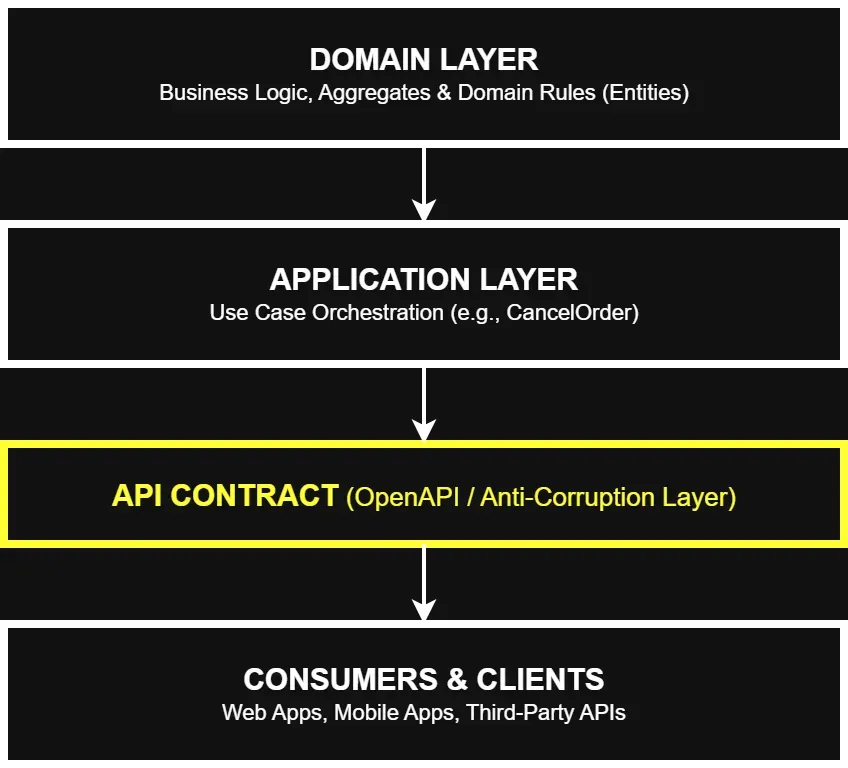
This is not about writing an OpenAPI file before coding. In mature enterprise architectures, it serves a deeper strategic purpose: isolating public interfaces from internal storage engines.
A critical antipattern in software creation is exposing database schemas directly through service endpoints. When these interfaces mirror base storage structures, they force client applications to grasp persistence logic. Consequently, any backend refactoring or migration instantly becomes an expensive breaking change for consumers.
Domain-Driven Design (DDD) resolves this by positioning the contract as the formal boundary of the operational domain:
To deliver long-term commercial value, contracts must express clear operational intent:
When designed around domain capabilities rather than database structures, the API adapter behind the OpenAPI contract can act as an Anti-Corruption Layer. This means it can translate external representations into domain concepts and protect the internal model from external coupling.
Engineering teams can modernize legacy databases, swap ORMs, or transition to microservices layouts without breaking a single consumer integration. For technology leaders, this isolation translates directly into lower software maintenance costs, higher system reliability, and significantly faster time-to-market.
An OpenAPI file is a living blueprint—written in YAML or JSON—that defines how an interface behaves before anyone writes a single line of real code. Once established, this contract powers the entire delivery lifecycle.
It all starts with code generation.
Automated tools parse the specification to instantly build routing models, parameters, and data structures, significantly reducing manual setup scripts. This removes setup friction while eliminating simple human mistakes—like typos or mismatched field names—that usually break builds later on.
The benefits extend directly to client applications through client SDK generation. Frontend and mobile teams avoid writing custom HTTP requests or parse JSON line by line, since the spec generates a ready-to-use client library in their language of choice.
Backend engineers benefit just as much by generating server stubs. These stubs derive directly from the specification, providing the baseline code structure, complete with pre-configured endpoints and response structures. Because the routes are already wired up, developers can skip setup and focus immediately on writing real application logic.
Finally, the specification acts as an automated guardrail in production through continuous validation. When supported and explicitly configured, an API gateway can validate incoming requests against schemas derived from the API specification before forwarding them to backend services. If a payload is missing a required field or sends the wrong data type, the system rejects it automatically.
By tying these tools together, OpenAPI turns a simple design agreement into a fast, reliable mechanism for rapid software delivery.
Adopting an API-First strategy requires more than an agreement on process. It demands a cohesive toolchain that uses the OpenAPI Specification as a unified reference repository across every phase of delivery.
When properly integrated, these tools automate manual handoffs, enforce contract compliance, and enable true parallel execution. Teams do not need to overhaul their entire stack overnight; this framework can be adopted incrementally, starting with design and mocking before expanding across the pipeline.
The workflow begins in the design phase, where product managers, architects, and engineering leads collaborate to define the API contract before writing business logic.
Rather than drafting static documentation, teams use dedicated editors that offer real-time linting, structural validation, and visual previews. Tools like Stoplight Studio, Swagger Editor, and Postman API Builder allow engineers to author valid OpenAPI definitions quickly.
Catching design flaws, naming inconsistencies, or missing edge cases at this stage costs a fraction of refactoring production code later.
Once the initial specification is merged, parallel execution becomes possible through automated mocking.
Mock servers parse the OpenAPI schema and immediately expose working HTTP endpoints that return realistic sample data. By utilizing tools such as Prism, WireMock, or Mockoon, frontend and mobile developers can start building user interfaces against simulated endpoints on day one.
They no longer wait for backend infrastructure, databases, or route handlers to be implemented.
Once the contract is sufficiently stable, implementation shifts toward automation.
Instead of manually writing data transfer objects, routing structures, or HTTP client calls, teams generate them directly from the schema. On the client side, tools like OpenAPI Generator, Fern, or Orval produce strongly typed SDKs complete with serialization logic and editor autocomplete support.
On the backend, server stubs scaffold route handlers and payload validation rules instantly. Developers skip boilerplate setup and focus entirely on essential business logic.
As codebases naturally evolve, they risk drifting away from the original specification.
Contract testing ensures that the running application strictly adheres to the schema and prevents accidental regressions from reaching staging or production environments. When interfaces must evolve to support new busineess requirements, these tests validate intended schema updates while flagging unannounced breaking changes instantly.
Frameworks like Schemathesis or Dredd run automated tests against the codebase within the CI/CD pipeline. They generate test cases based on the OpenAPI properties, verifying that endpoints accept expected payloads and return accurate status codes and response headers.
The lifecycle concludes at the network perimeter.
Modern API gateways ingest the OpenAPI specification directly, turning the design contract into an active security and operational guardrail in runtime. Solutions such as Kong, Tyk, and AWS API Gateway evaluate incoming requests against the published schema before routing traffic to backend microservices.
Invalid payloads, malformed JSON objects, or unauthorized fields are rejected at the edge, protecting internal components and keeping database environments clean.
Replacing rigid workflows for a deliberate design contract highlights the structural gap between modern speed and legacy friction points:
A close look at these hidden bottlenecks reveals a clear divide in how teams build software.
Traditional methods rely on sequential workflows and tightly coupled systems, locking teams into internal logic and difficult separation. In sharp contrast, API-First establishes contracts before coding begins, enabling parallel execution and external-first modularity. Hence, this foundational pivot gives engineering squads true autonomy.
Moving far beyond abstract theory, this methodology powers production systems across diverse sectors, ranging from enterprise SaaS to high-scale digital retail.
This architecture adapts efficiently across core operational domains, providing utility for diverse application ecosystems.
First, multi-channel platforms demand a unified source of truth. By decoupling data from presentation, an API-First core allows web, mobile, and connected devices to consume information independently.
A similar pattern powers headless CMS and e-commerce, where platforms like Strapi or Contentful follow these same principles to allow content creators and frontend developers to work separately, without dependencies.
Also, in domain-specific contexts like developer platforms and public APIs—where teams expose functionality such as payment processing, logistics, or authentication to third parties—an API-First model has proven to be a highly effective approach, largely because a clear, stable interface effectively serves as the product itself.
Finally, in agentic ecosystems, modern systems can expand to integrate artificial intelligence. Because Model Context Protocol (MCP) and API-First share a reliance on structured contracts, products already using OpenAPI can adopt this protocol:
This modular coupling prevents the accumulation of technical debt associated with custom AI scripts, making certain that agentic setups remain stable, secure, and completely synchronized with your technical foundation.
The transition to this kind of model involves adjusting team habits, aligning workflows, and establishing governance. Beyond tooling, successful adoption relies on a structured organizational checklist:
In a modern product ecosystem where services and teams operate independently, this disciplined framework supports scalability for distributed teams.
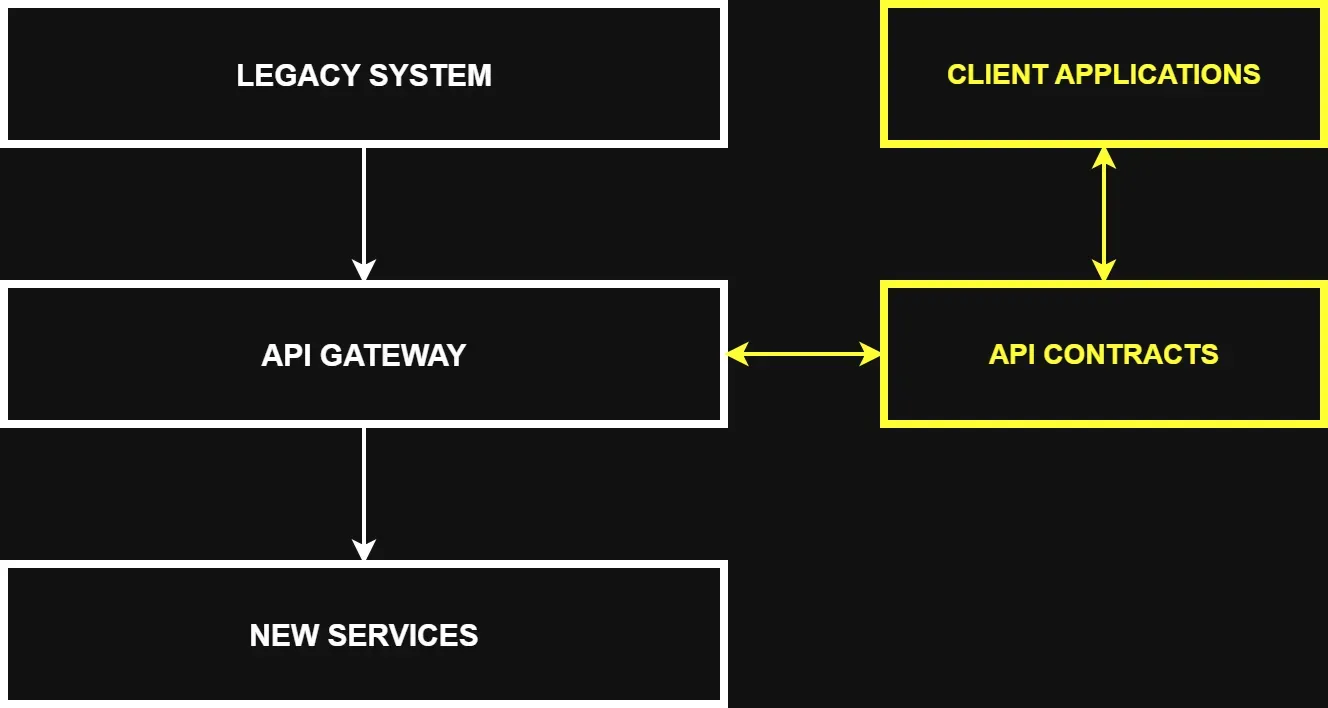
Tackling legacy modernization without falling into the trap of risky, large-scale rewrites requires a strategy that delivers continuous value without paralyzing business operations. Building directly on the decoupled interface contracts established earlier, API-First design naturally aligns with progressive migration frameworks—such as Martin Fowler's Strangler Fig approach [2]—to make incremental system evolution both safe and viable.
A stable interface layer positioned in front of aging infrastructure acts as a facade that safely routes traffic between old components and refactored services, isolating consumers from internal backend volatility.
Faced with a disruptive replacement that halts business continuity, organizations evolve systems step-by-step while those API contracts keep client applications entirely uninterrupted. In other words, this ensures a frictionless, secure, and cost-effective transition, securing ROI by drastically lowering migration risk, reducing legacy overhead, and maintaining services free from disruption throughout the transformation.
As the parallel workflows and modular building blocks established above compound over time, the business case becomes measurable in concrete financial terms: front-loading interface contracts shrinks total cost of ownership while accelerating revenue delivery.
Traditional workflows trap engineering squads in rigid dependencies where waiting for backend logic consumes weeks of paid capacity. By leveraging early simulation mechanisms, multidisciplinary teams compress multi-month cycles into agile, weeks-long sprints—decreasing lost capacity and improving time-to-market advantages [1].
Financial evaluations across the industry document this operational shift. Forrester’s Total Economic Impact (TEI) studies indicate that Microsoft Azure API Management delivers a 315% ROI with a payback period under 12 months, accelerating time-to-market by 50% while improving management and support productivity by 80% [3]. Similarly, Twilio’s platform model generates a 190% ROI with a payback period under 6 months [4], while independent IDC research on Stripe quantifies measurable operational efficiencies and improved conversion by exposing standardized capabilities [5].
Productivity metrics internally validate these financial returns. AWS demonstrated that systematically improving developer experience (DevEx) yields a 15.9% boost in engineering productivity [6]. Concurrently, Spotify’s internal portal data indicates that engineers leveraging standardized API building blocks ship code twice as fast and register 2.3 times higher activity rates [7]—quantifying the direct cost impact of reclaiming lost sprints.
Organizations eliminate the recurring cost of paying developers to duplicate business logic across web and mobile applications by assembling capabilities once through a unified single source of truth.
This corporate adoption aligns with the macroeconomic landscape documented in Gartner's 2024 research on API Management, which captured both market maturity and the requirements of an API-First strategy:
Ultimately, this shields budgets from reactive maintenance and custom scripting. Standardized platform integration streamlines operations, directing organizational resources entirely toward revenue-generating innovation and proactive growth.
Effective risk management requires addressing the threat of production environment failures, positioning API governance as a risk mitigation layer for capital investment. Technical stability directly protects system integrity, serving as a safeguard against costly operational disruptions.
Addressing specification flaws during initial design phases alters financial scaling by resolving issues before deployment, incurring significantly lower costs compared to late-stage remediation in production environments.
Automated contract testing provides a systematic defense against breaking changes that risk destabilizing consuming applications. By formalizing expectations between consumers and providers prior to deployment, teams shift risk left, replacing volatile, expensive end-to-end testing environments with isolated contract verification.
The enforcement of strict service level agreements (SLAs) safeguards mission-critical integrations such as payment gateways, ensuring high reliability when processing critical enterprise transactions.
API-First development constitutes a structural adaptation to modern digital product engineering, establishing itself as the operational norm where distributed teams, high user expectations, and rapid platform evolution prevail.
Placing interfaces at the center of your architecture unlocks enduring advantages, from parallel workflows across multidisciplinary teams and enhanced operational scalability to accelerated integration cycles and strict structural separation.
At Acid Tango, we view API-First as a pragmatic best practice. Whenever project constraints and timelines allow, we lean toward this approach to help software delivery accelerate commercial expansion and organizational scalability. If your current architecture is holding back your velocity, adopting an API-driven approach can serve as a flexible, high-impact pivot to secure long-term value.
In traditional development, backend logic is built initially, which frequently forces frontend teams to wait before taking action. In API-First, teams start by agreeing on the data contract. Once this blueprint is set, frontend and backend engineers can build simultaneously, significantly accelerating delivery.
No. Instead of discarding original software outright, the recommended approach is placing an API facade over the legacy system. This layer connects modern channels immediately while offering the freedom to replace underlying components progressively, without disrupting users or daily operations.
While operating behind the scenes, users experience three main benefits:
It means managing it like a commercial solution—complete with clear documentation, high stability, and security, rather than treating it as an internal afterthought. The mindset shift is viewing APIs as strategic assets that unlock seamless growth with partners and clients.
[1] "Journal of Software and Systems Development," The Eudoxus Press, 2023. Available: https://www.eudoxuspress.com/index.php/pub/article/download/4335/3177/8653
[2] Fowler, M. (2004, July 8). Strangler Fig Application. Martinfowler.com. Available: https://martinfowler.com/bliki/StranglerFigApplication.html
[3] Forrester Consulting, "The Total Economic Impact™ Of Microsoft Azure API Management," Microsoft Corp., TEI Study, 2025. Available: https://tei.forrester.com/go/Microsoft/AzureAPIManagement/
[4] Forrester Consulting, "The Total Economic Impact™ Of The Twilio Platform," Twilio Inc., Nov. 2021. Available: https://www.twilio.com/en-us/blog/company/news/tei-of-the-twilio-platform
[5] IDC, "The Business Value of Stripe for Modern Enterprises," Stripe Inc., White Paper, May 2023. Available: https://stripe.com/files/reports/idc-business-value-of-stripe.pdf
[6] AWS Enterprise Strategy, "Business value of developer experience improvements: Amazon’s 15.9% breakthrough," Amazon Web Services, Oct. 2023. Available: https://aws.amazon.com/blogs/enterprise-strategy/business-value-of-developer-experience-improvements-amazons-15-9-breakthrough/
[7] Spotify Engineering, "Build like Spotify," Spotify Technology S.A., Tech Report, Apr. 2023. Available: https://www.infoq.com/news/2023/04/spotify-success-backstage/
[8] S. Pillai, J. Santoro, N. Carter, and A. Jain, "Gartner's 2024 research on API Management" Gartner, Research Report G00804180, Oct. 2024.