Monday, September 29 2025What is Service Design, and How Can it Improve Your Customer Experience?
We will explain to you how service design can improve your customer experience and all the benefits you can reach from it.



As a Service Designer and former UX researcher, I've realized that defining a Service Design project and how to sell it to a client takes work.
First, it's not easy to find a client willing to go on a long journey to create or improve a service. Second of all, our clients may need help understanding the scope of this methodology.
So, I'm wondering. How can we know if clients need service design for their projects and objectives? Is there such a thing as a pure service design project?
Here is my experience, hope it helps.
As businesses diversify in governance, innovation, and strategy, always adapting to changing market trends, their needs become increasingly complex. Clients often need to learn what they ought to do to reach their business goals, so they ask external companies like us to help them.
However, in my short career as a Service Designer, I could not imagine how many parameters had to be considered to carry out a project sold as "Service Design successfully." In other terms, if you want to execute a project where the clients want to improve their service or product, you better know about Business and Strategy Design.
The good news is that these practices follow the same methodology, i.e., Design Thinking or the Lean Startup methodology.
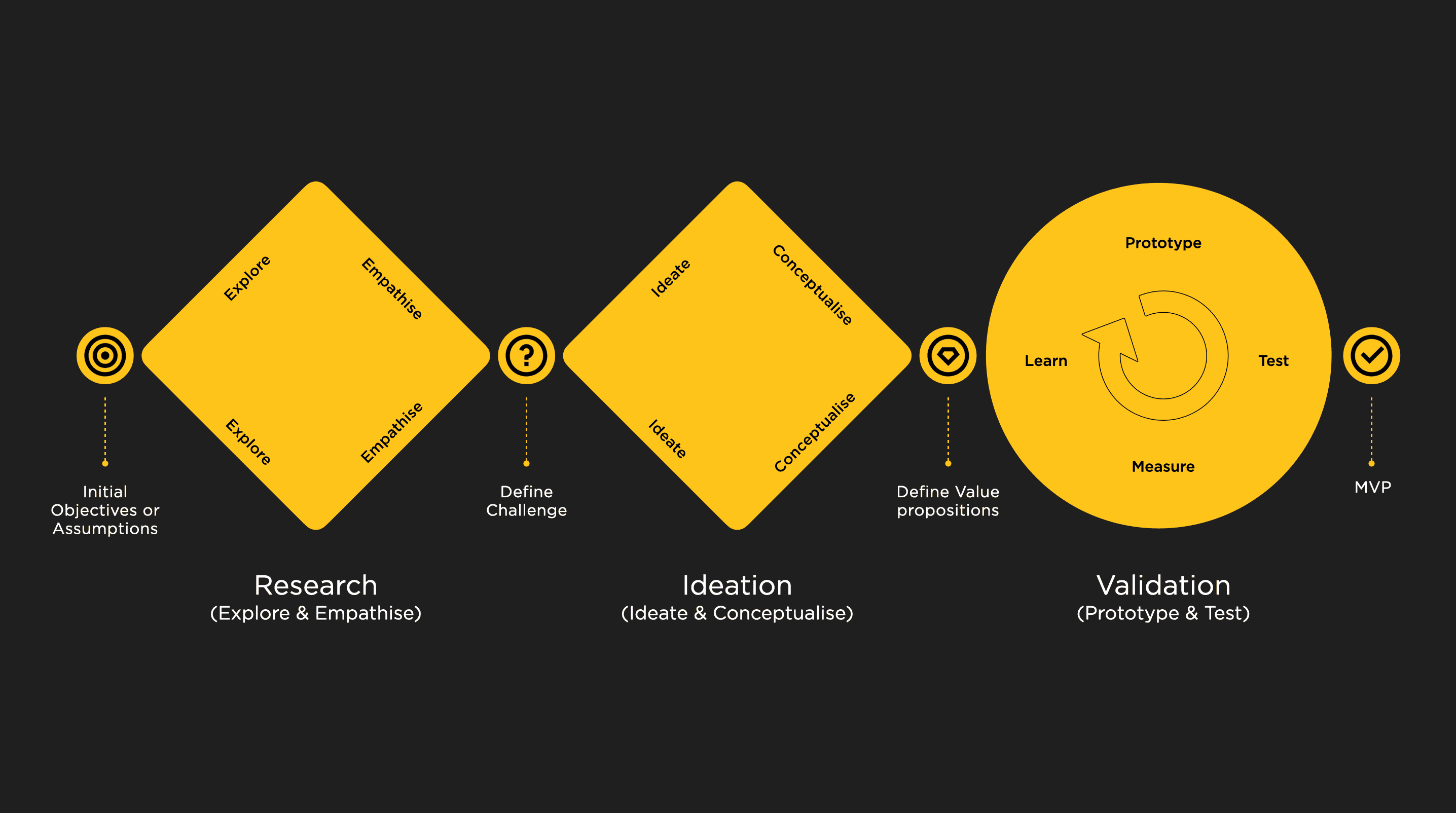
As we already said, these practices - and so service design - always follow the same pattern; only activities may vary depending on the need.
If you identify as a UX researcher, Service Designer, Business Designer, Strategic Designer, or Product Designer, be aware that to tackle today-complex projects, you better know what encompasses the other practices.
The key is to uncover where the client's initial objectives and assumptions come from. For example, if the client's objective is to add a new feature, revamp their product, or improve their service, the project starts incorrectly. Their objective should focus on the outcome rather than the way to achieve it. You may stumble upon a few scenarios when researching or conceptualizing the solution.
Do you need some examples? Here they are:
Scenario 1: Upon conducting the interviews, you discover that customers have more pressing expectations and frustrations.
Scenario 2: You discover that a part of the solution cannot be implemented due to the ownership of another department within the company, highlighting the issue of working in isolated groups. (i.e., silos).
Scenario 3: After conducting the research, you come to realize that the proposed solution could have an impact not only on how people work within their organization but also on their entire business model.
Many of our clients are startups in the pre-seed phase - i.e., when the idea has not yet become a minimum viable product (MVP), and they already want to develop their idea (or sometimes hunch) into the design to create an MVP as quickly as possible. However, this idea must initially be presented to the target audience.
Thus, there are three key activities to undertake, regardless of the client's goals.
The most difficult part lies ahead; persuading the client of the importance of undertaking the Research and Testing phase.
In future articles, I will explore various methods of validating assumptions, different types of prototyping and testing, and ways to persuade clients about the importance of research and testing.